Author: Jeff Morgan (Page 11 of 168)

Amazon buys Diapers.com for $540 million

Diapers.comAmazon got set to announce another acquisition this weekend. The target this time is a company that uses complex algorithms to deal with baby poop. Amazon is looking to buy Quidsi, the company that owns Diapers.com, for $540 million.

I don’t have any children, but I still know that diapers are about as hot a topic among new parents as the impending Call of Duty launch is among fifteen year-old boys. Quidsi is of particular interest to Amazon because of its technical approach to problems like stocking shelves. One of the company’s founders told Inc. last year:

So before we launched, we built proprietary software from scratch. We built software with computational algorithms to determine what the optimal number of boxes to have in the warehouse is and what the sizes of those boxes should be. Should we stock five different kinds of boxes to ship product in? Twenty kinds? Fifty kinds? And what size should those boxes be? Right now, it’s 23 box sizes, given what we sell, in order to minimize the cost of dunnage (those little plastic air-filled bags or peanuts), the cost of corrugated boxes, and the cost of shipping. We rerun the simulation every quarter. Using the right box probably adds close to 1 margin point.

Sound familiar? That’s exactly the kind of thing that helped Bezos make a name for himself. It’s also how Zappos, which Amazon also acquired not so long ago, ran their online shoe store.

The crazy part of the deal, though, is that Amazon paid $200 million over the company’s most recent venture valuation. I’m not sure why, unless they really wanted to be sure they were the ones to get it. Apparently Wal-Mart had also been sniffing around Quidsi.

Source: CNN Fortune
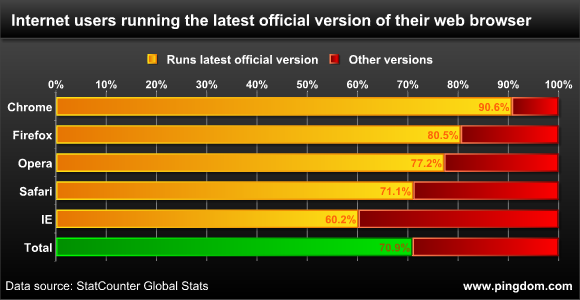
Browser update rate is surprisingly high

Browser update rate.

It’s no secret that internet technology advances much faster than most people can keep up. If you asked your average internet user, you can bet they would have no idea what HTML5 is, why it’s important, or what it means for the mobile web. Hell, they might not know what mobile web means.

That’s why this chart from Pingdom.com is so crazy. Look how many people are running the current versions of their browsers. Even though Chrome is a notoriously geeky browser, the 90 percent current version stat is impressive. I’m not willing to give credit to the users for most of this. I think we can all admit that the numbers would be much lower if users were totally responsible for the updates. Developers, on the other hand, have done a great job of encouraging updates or even background updating.

For some people, that’s a problem, but as technology gets more advanced, it becomes increasingly unlikely that the general population will understand it. Until we hit some sort of soft wall, where the next great leap will be like that of the silicon chip, we won’t likely see a general population of users who actually understand what the machine they’re using does. Why do you think your parents call you all the time about pop-ups? It’s because they click things without thinking and don’t understand that the “Whack the Fly!” game is actually an advertisement or a wormbait.

T-Mobile sells an iPhone cable

T-Mobile iPhone cable.

What’s this? Oh hello iPhone cable with T-Mobile branding. A tipster sent this to Engadget, but, as Engadget points out, T-Mobile did just make an ad that digs at FaceTime and AT&T’s network, all in the same breath. It’s a weird set of circumstances, but you’d have to think T-Mobile would be happy if it got to sell the iPhone.

Paid TV execs really don’t get it

Satellites.I’ve been writing here a lot about the development of online TV services and my desire to be able to truly cut the cord and fully rely on the internet for my media consumption. I don’t currently have a cable subscription of any kind, which makes me really really happy, but my system isn’t perfect and could definitely stand to get a lot better.

The biggest thing standing in my way are the paid subscription services. They show up every few weeks to say stupid shit like this about Hulu and similar services: “If I can watch Glee tomorrow morning and I don’t have to pay a pay TV service –- I think that’s bad.” That’s Dish Network’s VP of Online Content Development and Strategy, Bruce Eisen. Sorry, Bruce, but you’re a moron. For starters, Fox – you know, the company that broadcasts Glee – allows me to do this. Why do they do this? Because customers want it. That’s what being in any sort of delivery service is all about – catering to your customers.

Somewhere along the road to present day, guys like Bruce Eisen forgot that their companies exist to deliver a product that customers want, not to dictate those wants by delivering a mediocre product at a ridiculous price. Not to limit consumer access to content but to provide it. Every time a cable or satellite exec says something like this, I can hear PR firms squealing in dismay. “Bruce! You just told the customers you don’t want them to have what they want! You want to bleed them dry before they can have it! These people aren’t stupid!”

And there’s the other problem. All these execs like to talk as though we don’t understand their business, like we can’t possibly understand the position Hulu has put them in. Sorry for asking you to think, Bruce. Sorry for asking you to adapt. Sorry for asking that American business men do what they were born to do. Make things. We’ve stopped making and become a country of consumers. Well I, for one, am done consuming and I’m ready to make.

Yeah, Bruce, that’s from 30 Rock. I loaded it up on Netflix just now, scrubbed forward to the part I wanted and transcribed it. Why can’t you make things like this:

And less like…wait…hold on a sec. Just have to fire up the old satellite and dig through the DV-ah, fuck it. Nevermind.

The reason Facebook didn’t announce a phone

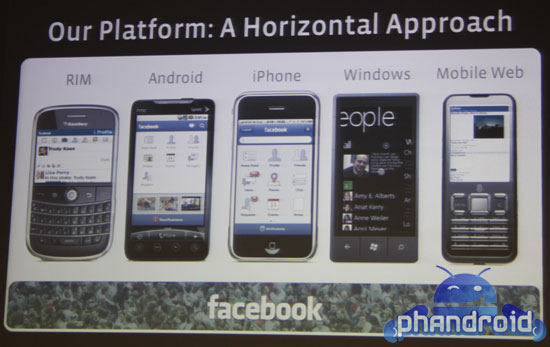
Facebook on all devices.

I’ve been skeptical of a Facebook phone launch since the moment I first heard of the idea. My biggest question was, why? Why would Facebook want to get into the hardware game? Why would they try to pull market away from existing platforms that are already using its applications? Why would they partner with a manufacturer and go through the headaches of fabrication just to have one more device that runs the Facebook app?

I can’t think of a single compelling reason to do any of that. There’s a reason Facebook didn’t introduce a phone at its mobile even this Wednesday, and that reason is the picture you see above. All of those devices run the Facebook app. All of them. That’s what Facebook wants. It wants all of them. All the devices, all the people, everyone, everywhere, using Facebook on a mobile device, all the time. They’ll get it, too.

Yesterday’s Facebook announcement was about leveraging third party developers, about getting all sorts of tools to further enmesh people in the Facebook platform, essentially for free. As the Phandroid article I’m sourcing this from puts things:

Now, instead of Facebook going it alone to create the perfect solutions, they’ve got a world of developers all “working for them” – for free – to make Facebook’s social and mobile platform infinitely successful. Android is no different. Every time another app or game lands on Android Market, Google has provided consumers with value. All they did was create the initial tools, and now thousands and thousands of people are out there building value for their product.

That’s what the mobile announcement was. It’s giving consumers value through quality experience and giving developers the tools to reinforce that quality experience. This is what will keep Facebook from turning into MySpace. Facebook doesn’t need a phone.

« Older posts Newer posts »

© 2026 Gadget Teaser

Theme by Anders NorenUp ↑