Page 146 of 258

Tablet week begins

Steve Jobs with his Apple.With all the fervor surrounding this week’s Apple announcement, I thought it would be appropriate to begin the week with a quote rumored to come from one Steve Jobs himself. It goes something like this:

“This will be the most important thing I’ve ever done”

Now, that’s not confirmed, but it’s being reported on several sites today that claim Jobs is as excited about the tablet as he has ever been about an Apple product. And let’s consider what he’s saying. For Jobs this is more important than changing the face of the smartphone market. More important than pioneering the App Store model for the cellular world. He’s essentially relegated the iPhone to amuse-bouche status, a preparatory device for what we’ll get to see this Wednesday.

I’m excited.
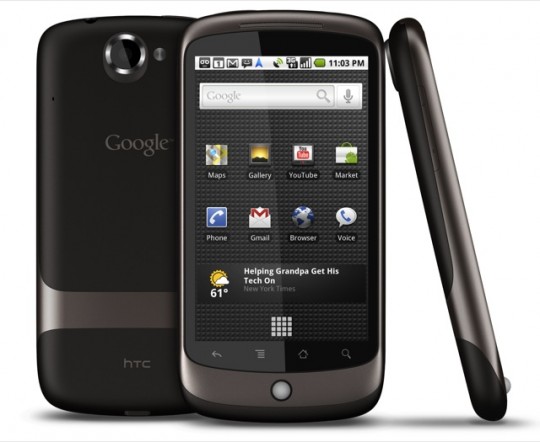
Nexus One bleeps your ####ing curse words

Nexus One.I’m always a little put off by profanity filters. They are increasingly built into video games and seem to find their ways into all sorts of other applications. What I didn’t expect was a filter on a cell phone, and then Google did it.

Yes, the Nexus One has a profanity filter as a part of its speech-to-text engine. At first I was pretty surprised. It seems mighty presbyterian of Google to pull something like that without talking about it. The real reason, though, makes a lot of sense.

We filter potentially offensive or inappropriate results because we want to avoid situations whereby we might misrecognize a spoken query and return profanity when, in fact, the user said something completely innocent.

So instead of something nasty when your four-year-old says ‘duck,’ all he’ll see is ‘####.’ Unfortunately, there isn’t a way to disable the feature, so you’ll have to write out that drunken text instead of just yelling it into your phone.

Kindle bestsellers don’t cost a thing

Kindle with a bookIt’s not a revolutionary concept. You want some visibility so you offer what would normally be a paid service or product for free. As word of mouth grows, you bump the price back to normal levels, occasionally higher, and profit. Easy enough.

That’s what many book publishers are starting to do with titles on the Kindle, the New York Times reported this weekend. The article focuses on Maureen Johnson, an author whose young adult fiction has climbed as high as number three on the Kindle best-selling charts. It’s being run for free on the device to drive interest in her upcoming sequel, which will release this February.

While some publishers – Random House and Scholastic for two – embrace the free model, others, like Hachette, find it “illogical.” They believe the price of ebooks is already too low, so why go any lower? In fact, a lot of publishers delay ebook publication for a few months after a book’s release to capitalize on hardcover sales.

Obviously, as time goes on, we’re going to see publishers get more and more creative to keep profits up in the face of lower prices for retail media.

$500 and $3,500 Blu-ray player: can you spot the difference?

Oppo's overpriced Blu-ray player.You’re probably thinking, “of course I can – they look completely different.” They do, you’re right. But they’re the exact same player. That Lexicon on top costs $3,500, whereas the Oppo is only $500.

It’s a strange story, one Wired picked up the other day. From what anyone can tell, Lexicon seemingly bought up a bunch of Oppo BDP-83s and packed the units into a new case. Yes, the whole player, chassis and all. Here’s Audioholics’ Clint DeBoer:

When we received the player the first thing we did was open it up to get a look at the inside. Imagine my surprise when I found that not only did the Lexicon share the same boards and transport as the Oppo – it was in fact AN OPPO BDP-83 PLAYER, CHASSIS AND ALL, SHOVED INSIDE AN ALUMINUM LEXICON WRAPPER.

There is one small difference – the Lexicon has a THX certification. The Oppo does not. How’s that for three grand?

Source: Wired

Passwords haven’t improved

Password field.It’s rarely news that most people use terrible passwords. There are just so many to remember, and really, no one is all that good at remembering completely random strings of letters and numbers. Recently, though, we got a little more data behind this widely accepted fact.

RockYou, a widget service for social networking sites, was recently hacked. The hacker retrieved passwords for 32 million accounts, which were stored in a database as plain text, and posted them online. Security firm iMPERVA took a look at the passwords and found some ridiculous stats. The most common password? 123456. That was followed by 12345, 123456789, and Password. That capital P is definitely important.

iMPERVA esimated that a slow DSL connection could access one account every second using a simple dictionary hack. It’s hard to say whether people would use better passwords on sites that hold more sensitive data, but my inclination would be no. Why add more passwords to remember, even if they’re as simple as Password.

Source: Ars Technica

« Older posts Newer posts »

© 2026 Gadget Teaser

Theme by Anders NorenUp ↑