Author: Matt Byrd (Page 10 of 33)

A 15 Year Old Has Invented A Flashlight That Runs Off Your Hands

If that headline made you feel like you may not be contributing as much effort to society as you could…you’re not alone.

Yes, a 15 year old from Canada has created a flashlight that runs off of nothing more than your hands. While you might guess that magic is the cause (possibly evil magic) it in fact functions because of peltier tiles, which generate an electric currency when one side of the tile becomes hotter than the other.

In this case, the exterior of the handle is heated by your hands, while the interior components remain cool. Specifically, the exterior must remain 5 degrees Celsius hotter than the interior for a useful enough current to be produced.

The developer calls this the design’s greatest flaw, since being humble is much easier when you are a 15 year old genius.

Dubbed the hollow flashlight because of its hollow handle, the design is still in a sort of prototype phase and is currently making its rounds at various young achievers contests, including the worldwide 2013 Google Science Fair, where it finished in the top 15.

Garnering impressive accomplishments aside, there doesn’t seem to be much direction for the hollow flashlight as there is only the one known model and, no matter how intelligent they are, 15 year olds usually don’t mass produce on their own.

This is a great design, though, that improves upon some recent battery free flashlight ideas, by functioning off something you always have easily on hand (pun sadly intended) without relying on cumbersome and time consuming mechanics.

Hopefully then someone picks up the concept, as some form of this design would ideally be in every emergency kit worldwide.
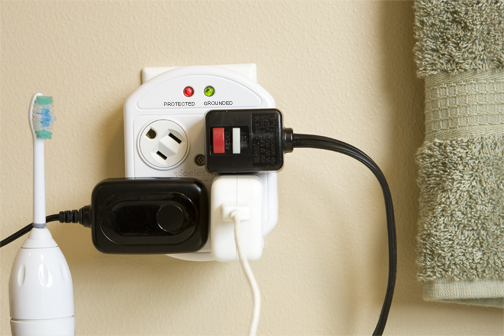
An Outlet that Changes the Plug-In Game Forever

360_Electrical_SurgeProtected_Adapter_Bathroom_504x336

WOW, this was a tough decision.

See, there’s only so much room to feature all of the great gadgets of the world on this blog, and some days, the pickings can be overloaded.

For instance, today brought us the world’s smartest microwave, a urinal that doubles as a sink, a motion detecting Nerf sentry gun, and a health monitor for the home that functions similarly to something off of “Star Trek”, just to name a few innovations.

But in the end, I had to go with something we could all use in our lives. It’s a device that manages to be simple yet revolutionary, as it completely changes the world of gadgets forever.

It’s an electrical socket that rotates.

Brought to us by the good people at 360 Electrical, this outlet features sockets that can not only rotate, but actually maintain an electrical connection while you maneuver them. That means that all of your devices that don’t quite fit (most likely due to those cumbersome “box” like plug-ins that manufacturers still prefer to use) will still be active no matter what position you set them in, and you can finally fit them all into one outlet without relying on a series of surge protectors, or voodoo curses.

Best of all, the outlet plugs in to your current outlet with little installation required. That means it’s not only compatible with your home, but can easily travel with you as well.

Should that not be enough, they also have power strips that perform similar functions as well.

It’s not often that a device comes along that once and for all addresses a basic (but prevalent) technological need, but this is certainly one of them, and should be worthy of every gadget users attention.

New Program “Glassbattle” Provides an Interesting Look at Gaming With Google Glass

With Google Glass in the hands of users all over the world, the mysteries regarding it become fewer and fewer every day.

However, that isn’t to say that some do not remain. While the biggest is going to be what kind of tech world are we looking at when everyone conceivably has access to its capabilities, a smaller, but still intriguing, query is how gaming will work on the device.

So far we only have the app “Starfinder to give us a hint. Unfortunately, its gameplay of locating and naming constellations faster than your opponents probably doesn’t exactly inspire gamers everywhere to start dreaming of the future with Glass.

However, “Glassbattle” from developer Brick Simple may do just that.

“Glassbattle” is nothing more than a remodeling of the classic game “Battleship” brought to Google Glass. To play, you and another user are given grids that indicate where your ships are positioned. Turn by turn you call out X and Y coordinates through the Glass microphone and attempt to hit all your opponent’s ships points to sink them. Sink them all, and victory is yours.

It doesn’t exactly differ much from the classic board game, but honestly it is the perfect fit for technology like Glass as it allows you a familiar archetype, but uses the hands free Glass system to present it in a way never before possible. It may prove to be just the type of title that slowly opens the door for other game developers to get a feel for how Glass is going to enhance the experience.

Okay, so admittedly it’s not exactly “The Last of Us,” but Glass has to start somewhere with gaming, and this looks a hell of a lot more promising than naming constellations. 

Volvo’s Demonstration of Their New Automatic Braking System is a Must-See

brake

As a rule I like to be in control of a car completely while I’m driving, to the point where I often don’t even use cruise control. While some of that is wanting to experience the thrill of driving completely, there is a small part in the back of my mind that doesn’t trust leaving something so potentially urgent in control of a machine.

When it comes to features like self-parking cars, or even self-driving cars, then, I tend to steer clear.

However, looking at it practically, automated cars are the wave of the future, and will in some measure become commonplace in all models. Technicians at Volvo are working to make sure that inevitability isn’t one driven entirely by consumer curiosity and vanity, but rather filling basic needs to enhance driving for everyone.

Specifically, they are trying to perfect an automated braking system in commercial trucks that would allow them to avoid major collisions should the driver be dozing off at the wheel, or otherwise unable to properly react in time. Unlike some other “innovations” in the field like self-parking cars, this design appears to be frighteningly effective.

The truck in that video is moving at a steady pace of 40 MPH, and is about to hit two vehicles (one completely stopped, and the other moving much slower). In both cases though the automated braking system kicks in completely outside of the influence of the driver,once its realized the driver is not reacting, and brings the truck to a stop right before it collides with the vehicle.

What’s really impressive, yet somewhat scary, is the reaction time of this system. Obviously not wanting to “jump the gun” so to speak on stopping a vehicle automatically, the system waits until the last possible moment to initiate braking, and as such stops the truck mere inches away from danger, making the results look like something that wouldn’t be out of place in a Hollywood driving sequence.

While no specific plans regarding the implementation of this system in future vehicles are present as of yet, with Europe requiring similar systems to be mandatory by 2015, you can expect to hear more about this soon from Volvo and more manufacturers.

It might be scary to essentially trust your life in the hands of a system, but if they can really get it to perform as well in real road environments as they do in these situations, this could be the start of a safer, though still almost too close for comfort, future

The Qlocktwo Aims to Make Letters the New Numbers

QT_frontal_black-ice-tea_screen_EN

Do you know what an “Oh wow, that’s really cool!” buy is?

It’s something you buy that’s not necessarily of strong particular use, nor do you have a strong personal desire or need for it, but instead you purchase it just so when someone sees it, you get to hear them say “Oh wow, that’s really cool!” This mostly extends to home or office decoration, but many cars, clothes and other goods have been purchased with the sole intention of producing that effect.

The Qlocktwo from German designers Biegert and Funk (which is just a fantastic 70’s soul band name) definitely accomplishes that, as evidenced by the fact that it was my exact reaction upon seeing it.

In case it wasn’t clear from the picture, the Qlocktwo is a wall clock (with a wristwatch model available) that foregoes the old fashioned number system (which in turn replaced that weird reading shadows thing that apparently was once the rage), and instead tells you the time in a series of phrases like “Half past Two” or “Quarter to Six,” making its communication closer to the same methods we often use to relay that information amongst each other.

Made of wood, available in several languages, and featuring a bright display visible in most any light conditions, the clock updates its message every five minutes, and comes in a variety of models including the mentioned wristwatch Qlocktwo W, an alarm clock compatible Qlocktwo Touch, and a Qlocktwo Large which is an as advertised larger version of the regular model.

It’s a fairly reasonable way to tell the time (because really, who needs to know if its 3:33 exactly?), but this is truly meant as an eye-catching piece you’ll have around the house to show off to anyone who may come through, or in an office when trying to impress guests or just improve the décor for your employees.

Running north of $600 depending on the model and vendor, the Qlocktwo might be expensive eye candy, but it’s some damn fine eye candy and one of the coolest clocks available.

« Older posts Newer posts »

© 2026 Gadget Teaser

Theme by Anders NorenUp ↑