Tag: facebook (Page 3 of 8)

Google launches Google+

Google+

It’s been a long time coming, but Google has finally made a serious entry into the social media market. It took three attempts – you remember Wave and Buzz right? No? That’s okay, no one does – but it looks like Google may finally have a winner on its hands.

Still, Google+ has a long way to go. The service has launched to a relatively small group of users and continue to be limited by invites, but that could provide the kind of hype Google wants for a new service. Here’s an excerpt from an article I wrote about the service for Bullz-Eye:

One of the coolest parts of Google+ is Hangout, which allows users to jump into text and video chat rooms with customizable accessibility. It’s a product that could easily punch a hole in Skype and become an amazing productivity tool. That’s especially true for the companies that have made the transition to Google’s online products.

Sparks, on the other hand, is the service’s big flop. It’s meant to be some sort of social news feed, but it’s cumbersome instead of sleek, slow instead of fast, and skimpy where it should be overflowing with information. Sparks actually surprises me in its shortcomings. Google has mountains of information about me. I’m always signed in to its email service, I use the search engine exclusively, I have an Android phone, I use Google Reader on a daily basis, and I’m writing this article in Google Docs. Why is it so hard for me to get a decent feed on Sparks?

For the rest of the article, head over to the Bullz-Eye Gadgets channel.

Did Facebook already peak?

Facebook cash.

There’s more talk than usual about Facebook these days, thanks to the big investment from Goldman-Sachs that could lead to an IPO this year. As investment opportunity looms large for the social giant, a lot of people are carefully examining the company to see whether or not it’s worth dropping some cash on shares.

There’s a lot to read, and while some of it is virtually useless (sorry, I don’t care whether 50 Cent thinks Facebook is worth $50 billion or not), there are a couple of standout articles. The most interesting I found was an article on CNN, in which Douglas Rushkoff compares the potential Facebook IPO to the AOL/Time Warner merger. It sounds a little off base, until you see just what Rushkoff is talking about.

Here’s a peek:

Indeed, 11 years ago this week, when AOL announced its $350 billion merger with Time Warner, I was asked to write an OpEd for the New York Times explaining what the deal between old and new media companies really meant. I said that AOL was cashing in its over-valued dotcom stock in order to purchase a stake in a “real” media company with movie studios, theme parks and even cable. In short, the deal meant AOL knew their reign was over.

The Times didn’t run the piece. Of course, the merger turned out to be a disaster: AOL’s revenue stream was reduced to a trickle as net users ventured out onto the Web directly.

Rushkoff goes on to cite other examples of overvaluation in the tech sector and makes a compelling case against a Facebook boom.

What to make of Facebook’s new messaging system

Zuckerberg speaking this week.Earlier this week Mark Zuckerberg held a press conference to announce a new messaging service. I say service because it’s not the email program that everyone was expecting. That’s part of the package, but it’s a small part and an optional one.

This new system is actually about conglomerating all of your message services – email, SMS, chat – in one place. The big issue, as Facebook sees it, is that we have too many places to look for our text-based communication with one another. By building the system into Facebook, Zuckerberg hopes Facebook can become your complete social hub for the web.

It’s more than that, though. While working on this project, Zuckerberg talked to high school students about the way they’re using email. Turns out, they aren’t. It’s too formal, which I can totally understand. I can get upwards of a hundred emails a day, and that’s a far cry from the deluge that other tech professionals will see. I don’t need to see, “Hi Jeff,” or “Hello Jeff,” or “Jeff, how are you today?” from promoters and marketers or even my coworkers. I need information, and I prefer that it’s short and to the point.

Zuckerberg is obviously pointing at the end of email, or at least the kind of formal, subject-line message system we understand as email today. He can’t say that, though, if only because he’s Mark Zuckerberg.

The reason Facebook didn’t announce a phone

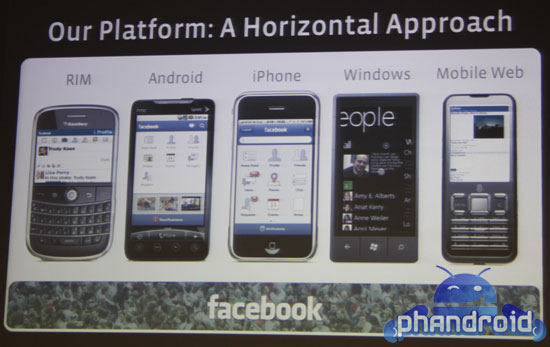
Facebook on all devices.

I’ve been skeptical of a Facebook phone launch since the moment I first heard of the idea. My biggest question was, why? Why would Facebook want to get into the hardware game? Why would they try to pull market away from existing platforms that are already using its applications? Why would they partner with a manufacturer and go through the headaches of fabrication just to have one more device that runs the Facebook app?

I can’t think of a single compelling reason to do any of that. There’s a reason Facebook didn’t introduce a phone at its mobile even this Wednesday, and that reason is the picture you see above. All of those devices run the Facebook app. All of them. That’s what Facebook wants. It wants all of them. All the devices, all the people, everyone, everywhere, using Facebook on a mobile device, all the time. They’ll get it, too.

Yesterday’s Facebook announcement was about leveraging third party developers, about getting all sorts of tools to further enmesh people in the Facebook platform, essentially for free. As the Phandroid article I’m sourcing this from puts things:

Now, instead of Facebook going it alone to create the perfect solutions, they’ve got a world of developers all “working for them” – for free – to make Facebook’s social and mobile platform infinitely successful. Android is no different. Every time another app or game lands on Android Market, Google has provided consumers with value. All they did was create the initial tools, and now thousands and thousands of people are out there building value for their product.

That’s what the mobile announcement was. It’s giving consumers value through quality experience and giving developers the tools to reinforce that quality experience. This is what will keep Facebook from turning into MySpace. Facebook doesn’t need a phone.

Facebook serving as an election predictor?

Facebook election results.There’s some interesting data around this year’s election results and the number of people who became “fans” of the winning candidates on Facebook. According to All Facebook, 74 percent of the House and 81 percent of the Senate victories were accurately predicted by the number of fans the winning candidates received.

Obviously this stat is a bit anecdotal without all the supporting evidence required to back it up (Did the fans actually vote? Did they vote for that candidate? etc.), but it’s interesting to see how Facebook engages the political spectrum. So much of what happens on Facebook is drivel, but everyone has that friend, you know, the one constantly sending you cause invites and voting reminders and all that. Those people, at least in my experience, tend to behave the same way in public – constantly talking politics and causes, so maybe it’s not so different.

At any rate, give a looksee to All Facebook and their awesome election tracker for more intimate details on each race and the Facebook correlation.

« Older posts Newer posts »

© 2026 Gadget Teaser

Theme by Anders NorenUp ↑