Category: News (Page 39 of 130)

Browser update rate is surprisingly high

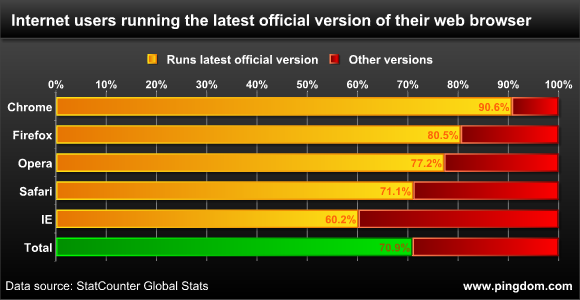
Browser update rate.

It’s no secret that internet technology advances much faster than most people can keep up. If you asked your average internet user, you can bet they would have no idea what HTML5 is, why it’s important, or what it means for the mobile web. Hell, they might not know what mobile web means.

That’s why this chart from Pingdom.com is so crazy. Look how many people are running the current versions of their browsers. Even though Chrome is a notoriously geeky browser, the 90 percent current version stat is impressive. I’m not willing to give credit to the users for most of this. I think we can all admit that the numbers would be much lower if users were totally responsible for the updates. Developers, on the other hand, have done a great job of encouraging updates or even background updating.

For some people, that’s a problem, but as technology gets more advanced, it becomes increasingly unlikely that the general population will understand it. Until we hit some sort of soft wall, where the next great leap will be like that of the silicon chip, we won’t likely see a general population of users who actually understand what the machine they’re using does. Why do you think your parents call you all the time about pop-ups? It’s because they click things without thinking and don’t understand that the “Whack the Fly!” game is actually an advertisement or a wormbait.
The reason Facebook didn’t announce a phone

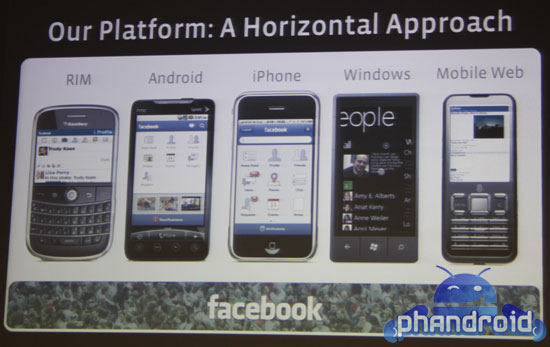
Facebook on all devices.

I’ve been skeptical of a Facebook phone launch since the moment I first heard of the idea. My biggest question was, why? Why would Facebook want to get into the hardware game? Why would they try to pull market away from existing platforms that are already using its applications? Why would they partner with a manufacturer and go through the headaches of fabrication just to have one more device that runs the Facebook app?

I can’t think of a single compelling reason to do any of that. There’s a reason Facebook didn’t introduce a phone at its mobile even this Wednesday, and that reason is the picture you see above. All of those devices run the Facebook app. All of them. That’s what Facebook wants. It wants all of them. All the devices, all the people, everyone, everywhere, using Facebook on a mobile device, all the time. They’ll get it, too.

Yesterday’s Facebook announcement was about leveraging third party developers, about getting all sorts of tools to further enmesh people in the Facebook platform, essentially for free. As the Phandroid article I’m sourcing this from puts things:

Now, instead of Facebook going it alone to create the perfect solutions, they’ve got a world of developers all “working for them” – for free – to make Facebook’s social and mobile platform infinitely successful. Android is no different. Every time another app or game lands on Android Market, Google has provided consumers with value. All they did was create the initial tools, and now thousands and thousands of people are out there building value for their product.

That’s what the mobile announcement was. It’s giving consumers value through quality experience and giving developers the tools to reinforce that quality experience. This is what will keep Facebook from turning into MySpace. Facebook doesn’t need a phone.

More pics of the Playstation Phone

Engadget picked up some more photos of the Playstation Phone over the weekend. Here’s what they’ve got to say:

The device appears to have an 8GB microSD card slotted, and at least 512MB of internal storage (though we’re hoping it’s the 1GB we’ve heard would be present). As you can see from the pictures in the gallery below, the device isn’t exactly thin — we surmise that the handset is around 17mm thick, or slightly thicker than HTC’s Touch Pro 2 (and funnily enough, about the same as the PSPgo). From a design standpoint, the device seems to have more in common with BlackBerry handsets than previous Sony Ericsson phones; that smoky chrome bezel which surrounds the device is definitely giving us Torch flashbacks. As always, we’re hard at work digging up more info on the phone (and potentially more images), but for now, just sit tight and enjoy the exclusive photos in the gallery below.

You can find that gallery over at Engadget.

More reasons Apple should release a Verizon iPhone soon

NPD mobile stats.

A few days back I wrote about the impetus for a Verizon iPhone launch in early 2011, mostly citing John Gruber from Daring Fireball. NPD just gave us a little information that could very well serve as more evidence of the impending release. The iOS market is actually shrinking, while Android is exploding. You don’t have to be a genius to see how a Verizon iPhone could change that, or at least help Apple’s position.

It’s not that Apple isn’t doing well – its market cap proves that it is – but Android is on so many more handsets now. From Peter Kafka at AllThingsD:

So how did Android gain share? Because it’s on so many other new phones. Canned quote from NPD’s Ross Rubin: “The HTC EVO 4G, Motorola Droid X, and other new high-end Android devices have been gaining momentum at carriers that traditionally have been strong RIM distributors, and the recent introduction of the BlackBerry Torch has done little to stem the tide.”

Everest summit now wired with 3G

Everest summit.

The summit of Mount Everest now sports a 3G signal, enabling climbers to access the internet and make video calls from the top.

From the AFP:

Ncell, a subsidiary of Swedish phone giant TeliaSonera, says it has set up a high-speed third-generation (3G) phone base station at an altitude of 5,200 metres (17,000 feet) near Gorakshep village in the Everest region.

“Today we made the (world’s) highest video call from Mount Everest base camp successfully,” Ncell Nepal chief Pasi Koistinen told reporters in Kathmandu on Thursday.

“The coverage of the network will reach up to the peak of the Everest,” he added.
Climbers who reached Everest’s 8,848-metre peak previously depended on expensive and erratic satellite phone coverage and a voice-only network set up by China Mobile in 2007 on the Chinese side of the mountain.

The installation will also help tens of thousands of tourists and trekkers who visit the Everest region every year.

“This is a great milestone for mobile communications as the 3G high speed internet will bring faster, more affordable telecommunication services from the world?s tallest mountain,” said Lars Nyberg, chief executive of TeliaSonera, which owns 80 percent of Ncell.
The 3G services will be fast enough to make video calls and use the Internet, said the company, which also claims the world’s lowest 3G base at 1,400 metres (4,595 feet) below sea level in a mine in Europe.

« Older posts Newer posts »

© 2026 Gadget Teaser

Theme by Anders NorenUp ↑