Month: May 2010 (Page 2 of 6)

Google Pac-Man wrecks the world’s productivity

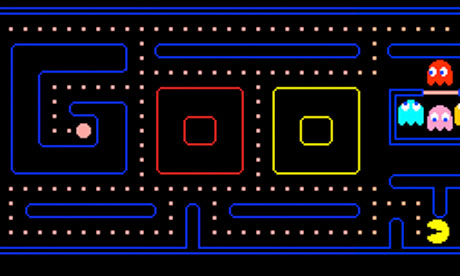
Google's Pac-Man tribute.Last week the Google logo was turned into a playable version of the classic Pac-Man. It was completely awesome, and I can honestly say I spent too much time chasing blue ghosts (and of course smashing my fists on my desk when one of them suddenly because a real ghost again just as my hungry, yellow mouth touched it). Apparently I wasn’t the only one playing.

I don’t know if you pay much attention to RescueTime but you better hope your boss doesn’t. RescueTime is a productivity analysis tool that shows companies how their employees are spending their time, supposedly in the hopes of helping them. The company did a little research on the time spent at the Google homepage when Pac-Man launched, and the results are astounding.

This weekend, we took a hard look at Pac-Man D-Day and compared it with previous Fridays (before and After Google’s recent redesign) and found some noticeable differences. We took a random subset of our users (about 11,000 people spending about 3 million seconds on Google that day) The average user spent 36 seconds MORE on Google.com on Friday.

If we take Wolfram Alpha at its word, Google had about 504,703,000 unique visitors on May 23. If we assume that our userbase is representative, that means:

-Google Pac-Man consumed 4,819,352 hours of time (beyond the 33.6m daily man hours of attention that Google Search gets in a given day)
-$120,483,800 is the dollar tally, If the average Google user has a COST of $25/hr (note that cost is 1.3 – 2.0 X pay rate).
-For that same cost, you could hire all 19,835 google employees, from Larry and Sergey down to their janitors, and get 6 weeks of their time. Imagine what you could build with that army of man power.
-$298,803,988 is the dollar tally if all of the Pac-Man players had an approximate cost of the average Google employee.

I hope you’ve enjoyed our Pac-Man data journey as much as we have. Next up in our on our data-hacking list, we’ll be digging in to find the laziest and most productive countries and cities in the world. Where do you think yours ranks?

Crazy numbers. I love stuff like this, even if it serves no practical purpose in my own life. Oh, and as far as that productivity thing goes, I can tell you where my city ranks. I live in a beach town. No one is ever doing anything.


The mobile world is Google’s oyster

Android.

I’ve spent most of my tech reading time over the past few days reviewing the world’s reactions to Google I/O. Google announced some pretty cool stuff for Android, and the company clearly has Apple in its sights when it comes to market share. Even more interesting to me, though, was that the “Microsoft” didn’t seem to be on anyone’s mind. John Gruber put together a great read on the subject, so I’ll defer to him here.

As Gruber sees it, Google is taking its gigantic, Android-shaped bite out of Microsoft’s pie, not Apple’s. Google is the licensed OS player because it licenses Android for free, not on a fee-per-unit basis. That says nothing of Microsoft’s crazy volume requirements to turn a profit. The company currently charges something between $8 and $12 per handset. When you hold just 6.8 percent of the world market share, that license fee is a joke.

The volume game isn’t necessarily where you find the profits, either. Nokia sells a LOT more units than Apple, but Apple still makes a better profit. Microsoft is in an absolutely awful position to make a dent in the market. Hell, they still haven’t even launched a competitive platform. Microsoft was already too late when the iPhone launched three years ago. I have to thank John Gruber for this Ballmer quote about the iPhone launch, which I had never seen before:

“There’s no chance that the iPhone is going to get any significant market share. No chance. It’s a $500 subsidized item. They may make a lot of money. But if you actually take a look at the 1.3 billion phones that get sold, I’d prefer to have our software in 60 percent or 70 percent or 80 percent of them, than I would to have 2 percent or 3 percent, which is what Apple might get.”

Well, Steve, I have bad news. The iPhone OS was just reported at 15.2 percent of the global market share. That 80 percent market share you were hoping for? Yeah, that’s never going to happen.

Source: Daring Fireball

Stickandfind.com crowdsources your lost gadgets

Stick and Find labels.Everyone knows that sinking feeling. You get onto your next train or the bus or you walk through your front door and realize you left it behind. Next to the table at the bar. On the ledge at the coffee shop. On the airplane. Wherever it was it’s gone, and you probably aren’t going to get it back.

Stickandfind.com, a new website dedicated to returning lost gadgets to their owners, wants to change that. The site is based off the idea that everyone knows what it’s like to lose a gadget and everyone hates it. The process is simple – you order printed labels from stickandfind.com and put them on your gear. Your labels are then associated with an account, which you can access any time to report lost equipment. If/when your gear is recovered, the finder contacts Stick and Find, which then acts as an intermediary between finder and owner. There is no annual fee, no contract, and no usage fee for retrieving lost gear. You only have to buy the labels.

It sounds a little farfetched, that someone might actually return that high value gear, but Stick and Find reports a 75 percent return rate on lost items. Stick and Find also cites a survey done by the Guardian in which 71 percent of those polled said they would return a fat wad of cash if they found one. When you consider that some 70 million cell phones are lost across the US each year, a 75 percent return rate means 49 million people could be a whole lot happier.

AT&T jacks their ETF, claims its unrelated to the next iPhone

AT&T spider.If you’re thinking about terminating your relationship with AT&T, do it fast. Come June 1, AT&T is raising its early termination fee from $175 to $325. According to the company, this has nothing to do with the impending release of the next iPhone.

Right, guys. Right. That big influx of customers you’re sure to get, not to mention all of us idiots who will re-sub to get the next iPhone, we have no bearing on the decision to nearly double your ETF fees. If anything, consider this your warning if you haven’t made the switch yet. I love my iPhone – believe me, I do – but I loathe AT&T. If you think you might hate it enough to call it quits before your two years is up, be ready to part with $325.

Oh, and in case you weren’t completely convinced this is about the iPhone, AT&T said it will be lowering the ETF for feature phones, down to $150 from $175. So just those new iPhone subs get screwed? Got it.

Source: WSJ

I’m convinced I need an iPad

iPad magazine.I’ve been undeniably impressed with the iPad since its launch, but I wasn’t convinced I needed one, until now. I’ve spent the last week at my parents’ house in Ohio. I’m lucky enough to work from anywhere, but it’s my recreational web use that’s convinced me I need an iPad.

There have been so many times throughout the week where I’ve wanted to look something up or show something to my brother, or just browse the web while we trade off on games of League of Legends, but my laptop felt too cumbersome and my iPhone just isn’t big enough. Kicking back with my feet on a desk and my laptop across my thighs leaves my knees aching. Carrying my laptop to the cement deck out back feels cumbersome, mostly because of the weight.

In the end, it’s about convenience for me. I want a device that feels big enough to browse on and watch videos and share things with the people near me. The iPhone is great as a one-man device, but it doesn’t hold up in a social setting. An iPad, though, would do just the trick.

« Older posts Newer posts »

© 2026 Gadget Teaser

Theme by Anders NorenUp ↑