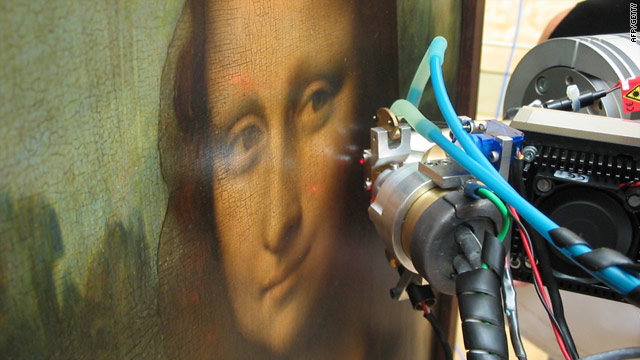
The Mona Lisa has been and will likely always be one of the most mesmerizing examples of fine art known to man. For centuries, scholars have marveled at the detail, the absence of brushstrokes, the subtle shadows, and of course, the source of her wry smile.
Science has unlocked the secret (or part of the secret) behind at least one of those attributes by using X-ray fluorescence to determine the composition of oils and paints Da Vinci used for Mona Lisa’s baffling skin tone and shadow work. From the original story at CNN:
[Researchers] found that some layers were as thin as one or two micrometers and that these layers increased in thickness to 30 to 40 micrometers in darker parts of the painting. A micrometer is one thousandth of one millimeter.
They believe this characterizes a technique of painting that uses a glaze, or very thin layer, to build up shadows in the face.
The manner in which Da Vinci painted flesh, “his softened transitions,” were pioneering work in Italy at the end of the 15th century, say the researchers, and were linked to his creativity and his research to obtain new paint formulations.
While this is certainly a victory for science, it also adds to the mystery behind Da Vinci and his technique. Micrometer-thin, virtually undetectable brush strokes made at the turn of the 16th century? I would love an explanation for that.
